Marc Gorelick and Lynn Broaddus: Giving ‘Til It Feels Good
Oct 30, 2026
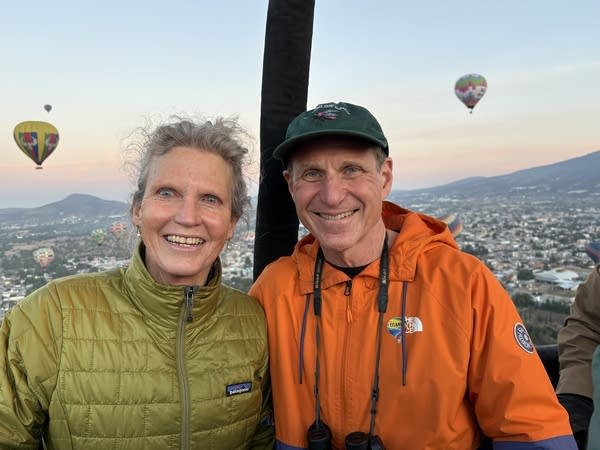
Her little transistor radio by her bedside, Dr. Lynn Broaddus recalls, “I listened to the AM station for rock and roll. I'd always be trying to call in and get that free record, and I did one time, and I got to go into the station.”
Dr. Marc Gorelick remembers, “When we were in the car, my dad tuned into WJRZ, an AM country western station. I was 8 when they switched formats to rock and roll. My dad was heartbroken to lose his country station. It was the only one in New York.“
Lynn and Marc met when he was in med school, and she was in grad school at Duke. “My PhD is a dual degree in botany and genetics.” Marc added, “We’re nerds. Aren’t all MPR listeners nerds?”
Marc traces his public radio listening to his life in New York, where he played the classical station. “Actually, there were two classical stations, one of them commercial, which was unusual, and I’d listen to one or the other depending on the signal.”
Lynn started listening to public radio in the early 1980s, when she lived and worked in rural Virginia. “A friend of mine, who was much more of a public policy nerd than I was, said I needed to listen, and I found WAMU in D.C. Then, when I moved to Durham, NC, some friends got married and asked for their wedding gifts to be donations to public radio. So I became a donor. I kept the habit as we moved around to Washington, D.C, Philadelphia, Milwaukee, and now here.”
Marc has served as a pediatric emergency medicine physician, combining clinical practice, research, and teaching. “I’ve moved into various leadership roles, but for the last 12 years of my career was in full-time leadership roles. Most recently, I retired from being the CEO at Children's Minnesota.”
Lynn’s career has focused on water issues in the NGO world. “I’ve run an NGO, worked in the foundation world, and then for the last dozen years, I have had my own consulting practice. A recent client is the Burke Center for Freshwater Studies, which was associated with Northland College and now is on its own. They asked me to facilitate a binational meeting of experts on what's causing the cyanobacteria, what some people call “blue-green algae”, outbreaks in Lake Superior. Now I am winding down the consulting and focusing on my writing.”
Each time they’ve moved, they’ve searched for community and for them, radio plays a key part. For Marc, listening to MPR helped him become familiar with his new community. He and Lynn were already fans of APM programs like Marketplace. “I listen to all the MPR stations: news, The Current, YourClassical. I even listen to Radio Heartland, which not many people have discovered.”
For Lynn, after 17 years, it was hard to leave behind her affinity for WUWM, her Milwaukee station. “I was good friends with their environmental reporter, and I felt close to many of the voices on air. Here in Minnesota, we have so many important environmental issues with agriculture and mining. And Minnesotans are obsessed with the weather.”
Both especially appreciate the strength of MPR’s local reporting and their statewide reach. “I like hearing stories by Matthew Holding Eagle III out of Bemidji, and we listen to Angela Davis for the call-in component. I like the way it engages the community and I learn from the questions they are asking,” said Lynn.
Both Marc and Lynn follow many APM podcasts. “’Sold a Story’ has rocked the nation; it could change the trajectory of the country.”
Marc serves on the MPR | APM board and appreciates the depth of journalism here. He shared, “Local journalism is dying in many places. We are fortunate to have vibrant local print and broadcast journalism. It’s really important. So much happens at the local level. MPR is doing the work regionally and nationally, too.”
Lynn added, “With everything that's gone on in the Twin Cities over the last 12 months, I always see the MPR photographers and reporters. I really appreciate that they're right there in the thick of it.”
Marc added, “Public media is part of our public infrastructure. I mean, we've got public schools, public parks, public libraries. I think of public media as part of that public infrastructure. For various reasons, all of them are under assault in different ways. It's important for us to support public media so we have that infrastructure and keep it available to everybody. You don't have to pay per use. But the infrastructure needs to be maintained, right? It's important that we pay our taxes, so we have good public schools, public libraries, and public parks; it's important for us to support public media so we have that infrastructure that's available to everybody. Otherwise, you end up with a tiered system.”
Marc and Lynn have made a generous, unrestricted five-year commitment to MPR’s comprehensive campaign.
“It was a stretch for us, but it felt good. A minister we knew used to say “It’s not ‘Give ‘til it hurts’. It’s ‘give ‘til it feels good.’ We feel good about our giving to MPR.